Lumio simplifying how aspiring designers break into fashion careers
Project Snapshot

Revenue Streams & Business Insights
Monetizes through mentorship sessions, company job postings, and premium visibility features, with an MVP focus on mentorship and hiring readiness.

Type
Standalone Mobile platform.

Impact
66.7% users would definitely try Lumio for job hunting.
8.3/10 average likelihood to recommend the platform.
Primary improvement area: Clearer onboarding and job application flow.
Short on time? Here’s a quick audio walkthrough.
A Large and Continuously Growing Talent Pipeline
India produces a massive pipeline of fashion talent
1L+ fashion & design graduates enter the workforce every year.
The junior designer pool stands at 2.5–3L+ candidates.
With 80% digital penetration, there are 17k–31k active early adopters ready for digital-first solutions.

A Pattern I Couldn’t Ignore

Problem
Growing Talent Pool with Limited Access to Opportunity


How Designers Navigate Existing Platforms




⚠️
⚠️
❌
✅
❌
⚠️
⚠️
✅
❌
❌
⚠️
✅
❌
⚠️
❌
✅
⚠️
⚠️
❌
✅
✅
Feature is built-in and easy to use.
⚠️
The feature exists but is not a primary focus and requires workarounds.
❌
Feature is not available.
Stage 1 — Portfolio
Designers upload to Behance for visibility. Reality: oversaturated, algorithm favors trends over hiring-ready work. Likes ≠ interviews.
Stage 2 — Jobs
LinkedIn / Naukri: Apply → share portfolio → context gets lost. Recruiters skim, not deeply evaluate.
Stage 3 — Mentorship
ADPList: Get feedback → generic, not hiring-focused → little real impact on getting jobs.
Hiring managers see only the portfolio, not the mentorship journey, and not the commercial thinking.
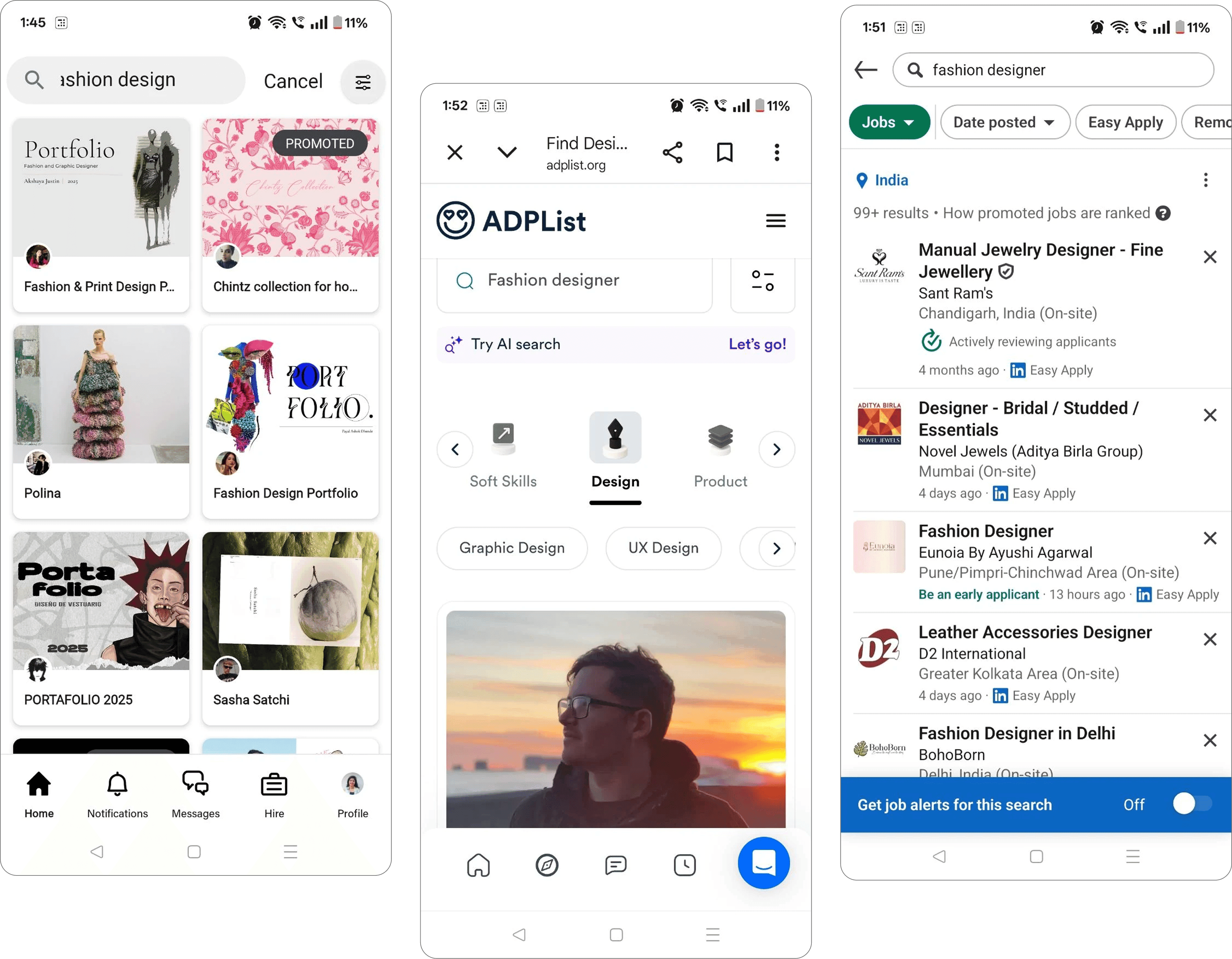
Research revealed that trust, not talent, is the biggest barrier to hiring. Designers need actionable feedback, while recruiters need credible hiring signals beyond portfolios.
Understanding the Two Sides of Fashion Hiring
What’s Holding Back an Otherwise Strong Skills

Talent Evaluator

Two Perspectives, One Gap in Fashion Hiring
Insights from 5 Senior Hiring Managers
Spoke to hiring managers across fashion house, export houses & retail brands.

The gap is not talent, but industry context & exposure.
Portfolios showcase visuals, but miss commercial thinking and market understanding.
Hiring remains connection-driven, limiting discovery.
“Portfolios look creative, but don’t show how designers think about what sells or what’s feasible.”
Insights from 11 Fresher Designers
Pattern observed across early designers struggling to get a job.
Unclear career direction across roles and domains.
Limited access to industry mentors.
Difficulty improving portfolio quality.
No clarity on where to apply.
"I’m willing to work hard. I just need direction and clarity on what I’m missing."


The gap isn’t talent, it’s missing credibility before hiring.
Design Hiring Runs on Private Networks
(Insights Uncovered Through Research & Conversations)

Fashion hiring remains closed, driven by consultants, referrals, and alumni networks, because companies distrust job boards (high noise) and need faster, lower-risk vetting. However, this leads to high costs (18–25%), limited diversity, and scaling bottlenecks.














Solution
Turning Potential into Proven Talent

Connecting emerging designers with industry experts to bridge the gap between potential and hiring readiness
Community-Driven Mentorship & Merit-Based Discovery
Discover and book curated mentors.
Receive structured, hiring-focused feedback.
Build portfolios with validated proof of skill.
Improve chances of interviews and job conversion.
Earnings + Credibility for Senior Designers
Earn through paid mentorship sessions.
Build credibility via visible mentee outcomes.
Contribute within a high-signal, curated ecosystem.
Companies Gain from Direct Talent Access
Access pre-vetted designers with proven capability.
Evaluate candidates through portfolio + feedback history (real signals).
Reduce hiring friction and improve quality of hire.
When Roshan mentors Aarohi and validates she’s ready, that endorsement becomes a visible hiring signal, reducing friction vs cold applications.
The Only Platform Where Mentorship Becomes a Hiring Signal
Mentor feedback and reviews become a scalable hiring signal: Structured evaluations and two-way reviews generate a dynamic Hiring Readiness score, aggregating multiple inputs into a consistent signal that updates with portfolio changes, reduces early screening effort, and helps mentors build credibility.
Only serious users are visible to recruiters. Your profile is shown only when you have a portfolio and chosen discipline, and selection is based on your work and thinking.
No resume needed. Your profile is the job application, so recruiters directly review your projects and save time.
Everything is fashion-focused and high-quality. You must select tags before posting, AI checks content, blocks irrelevant posts, and supports high-quality images.
Only verified companies can post jobs. Companies must be registered under government rules and their reviews are only given by people who have actually worked with them.
Iterations
Improving Mentor Discovery and Booking Through Iterations

Optimizing Mentor Discovery
Insight: Profiles designed for small circular views cropped & unclear in larger cards.
Problem: Large cards equals to low visibility (only 2 mentors per screen).
Decision: Use compact mentor cards
- Faster scanning.
- More options visible per screen.

Simplifying Mentorship Booking
Insight: Users seek portfolio + resume + career guidance together.
Problem: Multiple booking types creates decision friction.
Decision: Designed a single, unified booking flow
- Simpler decisions.
- Faster booking.
Key Product Decisions
De-emphasized navigation to highlight high-intent actions (CTAs).
The platform uses a freemium model: free access for browsing mentors and jobs, with revenue from paid mentorship sessions and premium visibility for companies.
Reducing friction led to higher intent actions, not just engagement.
Simplified Customer Flows for Key Actions
Apply for job

Booking Mentorship

Design Language
Typography


Chosen for its modern elegance and clean form aligned with the fashion domain, while also adhering to WCAG guidelines for font size and weight.
Colours
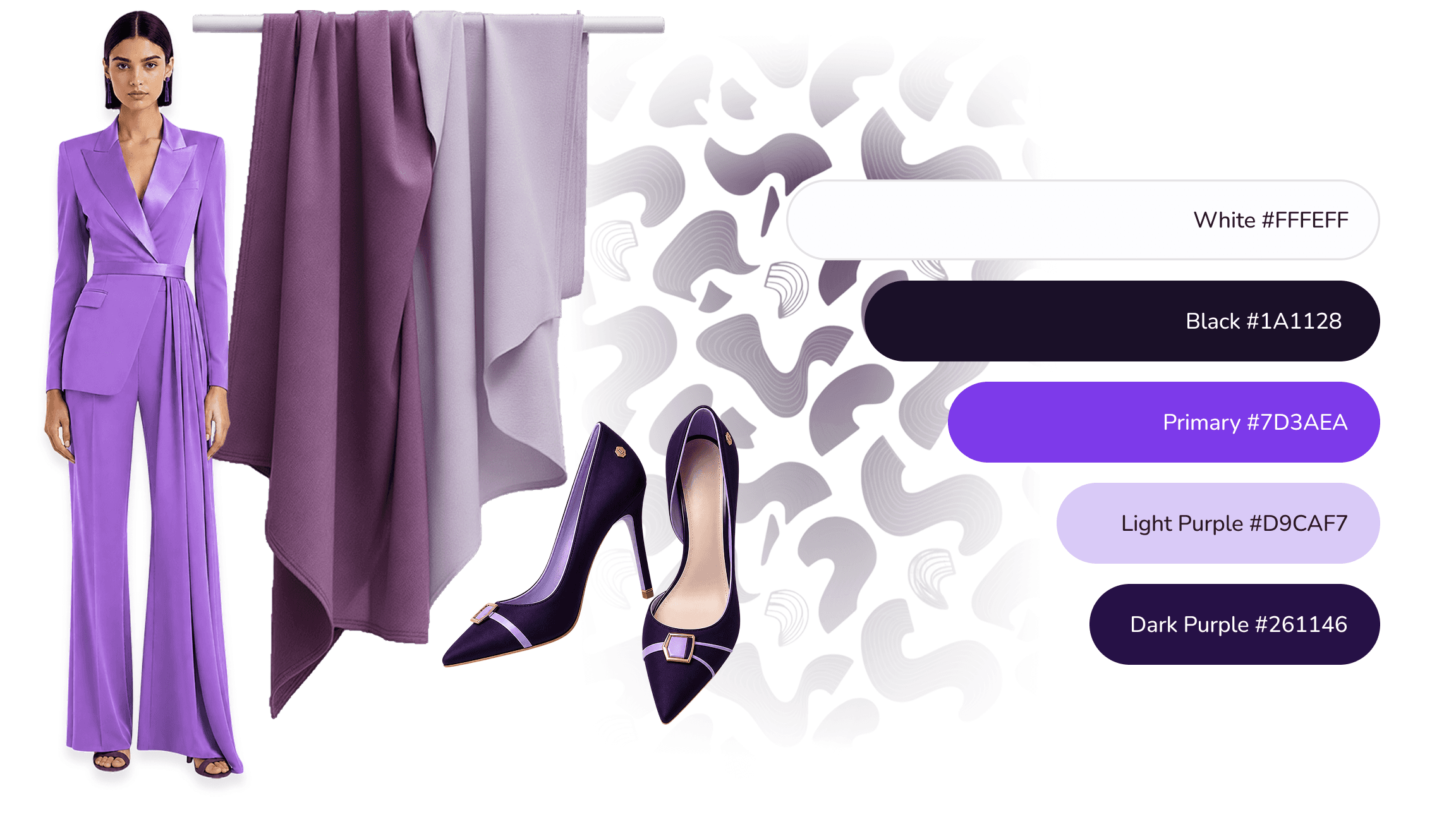
Soft purple that reads as creative and aspirational perfectly positioned between fashion's elegance and tech's innovation. Used for key CTAs (booking sessions, job applications) to reinforce commitment and reliability at critical moments.
Iconography
Phosphor Icons was chosen for its minimal and non-distracting, visual-first friendly, with consistent strokes for accessibility plus thoughtful details (like friendly feedback icons) that shape user perception.


 Mobile App Flow in Vercel
Product Evolution & Next Iterations
An AI-driven system suggests relevant mentors based on job openings and the roles a designer wants to apply for, ensuring guidance is directly aligned with hiring goals.
Expand job search filters beyond bottom sheets to support growing categories.
Use AI-assisted outreach to streamline company candidate communication.
Mentors can promote mentorships and webinars on the homepage.